


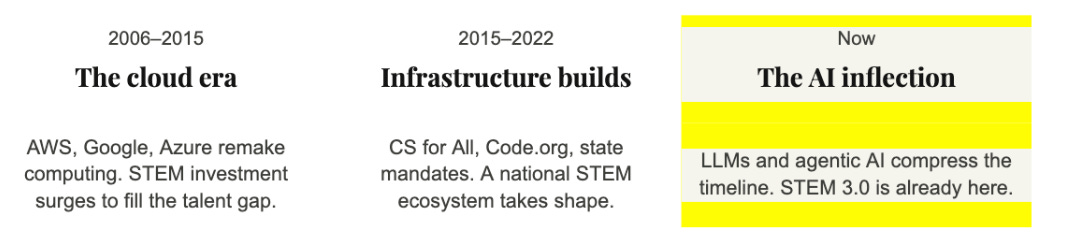
When STEMCONNECTOR launched in 2011, cloud computing was already reshaping the workplace at a pace that educators and policymakers were struggling to match. Amazon Web Services was launched in 2006, and Google App Engine and Microsoft Azure followed in 2008. Computing had transformed from a fixed, purchased asset into an infinitely scalable utility — and almost overnight, the demand for workers who could build on that infrastructure outran the educational systems designed to produce them.
That talent gap became a national conversation. Bureau of Labor Statistics projections consistently showed computing occupations growing far faster than any other sector, while universities produced only a fraction of the graduates needed to fill those roles. The alarm was bipartisan, urgent, and ultimately catalytic.
The investment that followed
How the cloud era built the STEM infrastructure we rely on today
The companies whose futures depended on cloud infrastructure — Amazon, Google, Microsoft, Salesforce — quickly understood that their long-term growth required a stronger talent pipeline for themselves and their customers. As adoption of these new technologies took root, companies who had not been previously considered “technology companies” found themselves needing developers and needed to integrate technology across all roles in their respective enterprises. This convergence of enlightened self-interest and civic purpose generated a surge of investment that went well beyond conventional CSR: companies invested heavily in STEM education at the local, regional, and national levels. Additionally, investment in STEM became a hallmark of a responsible corporation as it aligned with a variety of social indicators.
Government followed. The Obama administration’s Educate to Innovate Initiative launched in 2009 committed to engaging CEOs of leading corporations, recruiting 100,000 highly qualified STEM educators, and broadening engagement in the STEM workforce through role models and inclusive practices. In his second term, the Computer Science for All initiative committed $4 billion to bring CS education to every K-12 student. States began revising standards. New York City committed to CS in all public schools. Arkansas became the first state to require it for graduation.
STEMCONNECTOR was part of this broader mobilization. Our STEM 2.0 framework — built around Employability Skills, Innovation Excellence, Digital Fluency, and Hard Skills — contributed to the collective impact models that coordinated resources across the human capital development sector. Our State of STEM research identified five persistent gaps, from fundamental skills to geography to belief, that continue to shape our work today. Cloud computing was unlocking innovation across every sector of the economy which had profound impacts on the skills and competencies needed for workers to thrive.
Cloud computing didn’t just create demand for software engineers. It made the case for a broader, more integrated approach to STEM education — and the country responded.
The cloud also had a halo effect across the entire STEM ecosystem. Data demands elevated statistics and data science. Networked infrastructure created urgency around cybersecurity. Cloud-enabled fields like genomics and climate modeling drove new investment in math and physics at the university level. The interdependency of STEM disciplines became undeniable.
The new disruption
AI is remaking the labor market — and doing it faster
Artificial intelligence is driving the next paradigm shift, and the pace is frenetic. Large language models (LLM), agentic AI tools (Claude, ChatGPT etc.), and AI-powered automation are simultaneously automating tasks that once required human cognitive effort and creating explosive demand for workers who can build, train, evaluate, and govern AI systems — roles that require deep technical fluency in mathematics, statistics, and computer science, combined with significant domain expertise within the specific sectors where AI is deployed—ranging from jurisprudence and finance to clinical medicine. This new landscape necessitates a dual-disciplinary mastery, powered by teams that are integrated across technical and professional silos.
The immediate effect on labor demand is reminiscent of the early cloud era — but compressed. Today’s “hyper-scalers” are building enormous data centers that enable artificial intelligence. While the first cloud revolution enabled more computing power and scale, today’s advances are solving complex questions by digesting and processing incomprehensible amounts of data. Like the earlier cloud era, employers are finding ways to integrate this new capacity into their workforce with varying degrees of success.
In many fields entry-level work is being restructured around AI-assisted workflows, collapsing the traditional learning ladder that new graduates once climbed in fields like software development, data analysis, legal research, and financial services. At the same time, workers who can collaborate purposefully with AI tools — interrogating their outputs, understanding their limitations, applying them to real problems — are commanding premium value across every industry.
What this means for STEM education
The cloud era established that every student needs exposure to computer science. The AI era now requires that every student understands how intelligent systems function, where they fail, and how to use them effectively and ethically. That’s a meaningfully higher bar — and it applies across age and stage, from K-12 through professional credentialing.
Universities are launching dedicated AI degree and certificate programs and integrating machine learning across departments. Community colleges are developing accelerated credentials for AI operations roles. K-12 educators are building pedagogy for algorithmic thinking and critical AI literacy, as well as AI-assisted curriculum development and educator supports. Micro-credentials are emerging as a critical bridge between traditional degree pathways and the pace of change in the labor market. This flurry of activity is both exciting and overwhelming.
The equity stakes
The gap between emergence and impact is shrinking — and the risks are significant
In their recent book, Power and Progress, authors Daron Acemoglu and Simon Johnson argue that successive wave of technological disruption — the internet, cloud computing, AI — has raised the bar for meaningful economic participation. Each wave has also concentrated its benefits among those already positioned to capture them, while its disruptions fell hardest on the populations with the least resources to access it.
The gap between a technology’s emergence and its workforce impact is now measured in months, not years. The cloud era gave educators and policymakers a decade to respond. AI is already demonstrating that it will most likely not be as patient. In A new direction for students in an AI world: Prosper, prepare, protect, a Brooking Institution report released earlier this year, authors draw a critical distinction between AI-enriched learning and AI-diminished learning. In other words, it’s not just having AI tools available to students but how educational stakeholders use them.
The stakes of this AI moment are higher than anything we’ve experienced before. Workers without computational literacy face greater displacement. Communities without access to AI-literate educators and integrated programs face structural disadvantages that compound quickly. The geographic and demographic gaps our research has documented for years — between urban and rural, between well-resourced and under-resourced only widen in a new technological era.
Our response
STEM 3.0 is here
The first 25 years of this century have tested our community of practice repeatedly. Each time, a committed network of educators, employers, policymakers, and youth development organizations has risen to the challenge — not perfectly, but persistently. The infrastructure we’ve built in the cloud era: the partnerships, the frameworks, the convenings, the research — is the foundation we have to leverage and continue to build on now.
At STEMCONNECTOR, we’re mobilizing our stakeholder network with urgency, including convening corporations and education leaders around AI workforce strategy, piloting new models for micro-credentialing and work-based learning, developing effective approaches for developing human skills and ensuring that the institutions doing the most innovative work — from community colleges in Nebraska to research centers in Utah — have the national visibility and peer connections their work merits. Additionally, we are helping ensure that our partners have access to the technical expertise and scaling capabilities that they require to meet this critical need.
The call to action is the same one we’ve answered before, but louder. We invite our partners and stakeholders to join us — the window for building an AI future-ready education and workforce ecosystem is open now, and we need to seize the day together.